Showing posts with label Old Tokyo.. Show all posts

Saturday, September 20, 2008

Kawagoe

Day 18 (-13) Noren
Originally "Noren" was a shop curtain which was (is) hung in shop and restaurant doorway to show that they are open for business. The design usually says the shop's name, or perhaps its logo. It also provides some privacy and screens from direct view. One enters by using ones hand to push aside one of the split curtains, as you enter. No need to duck under it! Ones used in homes are decorative and of various length.


Today after a night of pouring rain we planned to go to Kawagoe despite the rain. Well was the forcecast out; we had the nicest weather since I arrived. We traveled by train on 3 lines with nary a delay at any station.
In its heyday in the Edo period, Kawagoe an old castle town thrived as a last rest stop for those journeying to the shogunate. Nowadays it offers a tantalizing glimpse of what Edo would have been like before the devastation of the 1923 Great Kanto Earthquake.
The town's main attraction and claim to fame is its traditional storehouses, or kura, that line a long street. Permission from the shogunate in 1720 sparked a construction boom of fireproof houses that are characterized by half-meter-thick walls built of wattle and daub (dozozukuri).
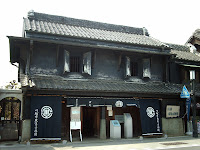
After a fire consumed the town in 1893, many more were built in the style favored by Edo merchants.
As many as 200 once lined the town, but today only a dozen or so of these remain, most now serving as craft shops or restaurants. The buildings have tiny windows with heavy shutters with interlocking edges, that can be sealed shut in the event of a fire. Steep tile roofs are crowned by immense, fire-deflecting onigawara (devil tiles). The street is wide and flat with no gutter,so very open looking. I feel we should see Samurai walking around the corner at any minute or maybe some Ninja on the roof tops!
We caught a bus from the station that took us first to Kitain Temple
The history of Kitain is thought to have begun when the monk Ennin founded Muryoju Temple in 830 A.D. We went over the residence there, lovely tatami floor and garden views from each room. Famous are also the 500 Statues of Rakan. There are actually 540 of these statues representing the disciples of Buddha. They were carved between 1782 and 1825 with no two statues alike. It is said that if you feel among the statues in the dead of night you will find one that is warm. Mark it, come back during the day, and you will see it is the statue most resembling yourself. However we did not venture back at night!
At one of the shops we saw two umbrellas open at front It was not raining so I was curious as to how they came to be wet. What I realised after a perusal was that when they get wet the flower pattern appears!

Thursday, September 18, 2008

Kagurazaka

Day 16 (-15)
Specialisation. The way many businesses in Japan serve or prepare only one thing results in
great detail and variety in food and products. This shop sells pickled vegetables, cucumber rakkyo (tiny onions) and it was just one of many specialising in garlic, onions, sembe (rice crackers) tea, or potato.


Today we are at the edge of a typhoon coming up the country, so had rain on and off all day. This time I did not wear my pink shoes, so they may last a bit longer. I had planned to do two chores first, change my airline ticket and give notice at the apartment, but I was able to do both these by phone. So we started by heading for Iidabashi and Kagurazaka, one of several place in Tokyo still with a touch of the Shitamachi. (low town) In its heyday it was renowned as a geisha district with many renowned geisha houses and ryotei (restaurants) of which a few rem
ain in the cobbled lanes. There are a variety of shops selling traditional goods, like split toe socks for kimono slippers, geisha wigs and kimono as well as lacquer ware and blue china.
It was too wet to have lunch at the canal cafe as we planned so instead we headed off to Sugamo, where the shops sell clothing, traditional foods, domestic wares, and reading material that cater specifically to the older generation. Older people from all over Tokyo and surrounding areas come to Jizo-dori for their shopping. The place is popularly known as “Harajuku for Grannies” (Harajuku being a popular shopping street for the young) because of the large number of seniors that visit it.


Since Jizo-dori and the rest of the surrounding area are mainly visited by older people, the authorities have taken care in building the area accordingly. The guide-board and rate-tables at the Station are all hand written and placed at eye-level and ticket machines are set lower. The pavements around the station and the rest of the area are flat and the streets have textured bricks to prevent slip. The area also has several places of rest with covered roofs. Even the advertisements in Sugamo cater to the elderly - information for daily life and advice related to health. All shops at Jizo-dori and the rest of Sugamo are also barrier-free, making it easy for the elderly with canes, walkers, or wheelchairs to enter and move around. Restaurants have food displays with prices rather than
menus, which are easier for the elderly to understand.

The most famous shops in Sugamo are the traditional cake shops and the clothing store Maruji. Maruji is popular for its red underwear that are coveted items among older women. These bright red undershirts and underpants, are considered lucky, besides being warm and comfortable; Maruji found it impossible to cater to the demand with just one shop, so now they have four stores at Jizo-dori.

At the traditional cake shops, the most popular item is the shio-daifuku - which is a rice ball with a sweet red bean paste at the center – for which Sugamo is famous, but we did not try this (have a treat planned in Ginza)

We ended up travelling back south by the Arakawa Railway Tram line,(previous Blog) to Kishibojimae station and then traveling on the newest line, the Futokoshin line to Shibuya, where there was this glass wall (right).

Wednesday, September 17, 2008

Tsukijima

Day 15 (-16)
It is not only Russia that has great station art. This is Kiyosumi-Shirakawa Station and the walls are all done with flattened metal work. It is stunning in effect and fascinating in the detail.


Today we explored the Kiyosumi garden and the Fukugawa Edo Museum. Along the approach street were half a dozen or more 'dolls' made with kimono and plastic bag heads; Perhaps part of some activity at the weekend. This is the same street where months ago I came across children's games activities set up.
The Museum is built like a small village with a cycle of lighting and effects that follow a day with sunrise, rooster crow, a cat meows on the roof, rain falls and the evening sets in with the fire warden calling for people to be careful of fires at night.
After lunch at the garden we went on down to Tsukishima which literally means 'moon Island" and is man-made just across from Tsukiji fish market. Though the area is modern some of the backs streets still retain some old world charm.The canal has fishing boats moored there and a new old style red bridge crosses the canal.
Fishing in the area dates from 1600 and before, when fishermen came from the Kansai district to supply fish to the Ieyasu Shogunate with the move of the Japan capital to Edo from Kyoto. Story has it some were granted fishing rights in exchange for reporting on activity in Tokyo bay. The Shogunate wanted premium fish, sea bream, carp, flounder and icefish. More common varieties were not for them!
Also it was estimated that the 18th Century Edo population exceeded 1,000,000 with the male population 1.5 times that of women. Many were unmarried so there was a huge group of men wanting food, and thus developed the pattern of small restaurants with a few dishes, setting up everywhere.
With fish being the most popular protein the range and style of fish is enormous in japan
In keeping with this Japanese trend we had dinner at the Sushi train in Meguro, and walked home so we could stop and get some mosquito repellent What we really wanted was one of these gadgets we saw on the gardener at Kiyosumi. Just as I asked what it was we saw the fumes drifting up from it.
Blogger refuses to load the picture so I will try another time. If you squint (or click on this picture) you can see the gadget on the backs of these women at the garden yesterday.

Thursday, August 7, 2008

Hot in Yanaka

Today was Brigid and Campbell's last day in Japan heading home tonight. They came up from Yokohama and I was to meet them at the Main Entrance of Osaki station (2 stops from me and on the way to Tokyo station). I had only been to the station to change platforms to go to Yokohama, and of course, when one makes arrangements like this, we found their is no 'main' entrance just a North & South one! But we all decided on the same one to start with so found each other quickly.
As I waited for them, I saw this group of kids lining up to stamp their sheets, part of a travel holiday event. The station staff was calling out, as any family came through the gate that the stamps were there.
We went off to Tokyo and left their bags in lockers just next to the Narita Express access escalator and booked a ticket (my Japanese being of use here). Then we went off to Ueno where I had planned a small tour of my favourite areas.
We walked down the Ameyoko lane of stalls and they did a bit of last minute shopping of tea, birch bark tea scoops, canisters covered in washi (Japanese paper) and chopstick rests. It was INCREDIBLY hot 34 degrees and HUMID. The heat seemed to press down on you as you walked outside. We went into every little air-conditioned place we came across for a brief respite.
We were looking for some children / baby books and found a small shop in the Ameyoko. I had told Brigid about seeing Mitsumata Anno drawings yesterday, but she didn't know him though Campbell did So we asked in this shop for his books. The young girl had no idea but directed us to an old man sorting stuff on a shelf. After a minute he got who I was asking about and went looking, but did not have any. Meanwhile as Brigid was buying some books, he gave me a calendar (1/3 A4 size) of Anno's pictures "a gift" as it was 2008. He had no other but got another of an artist I don't know and now can't remember and gave to Campbell a "gift". As Brigid pointed out she was the one who bought something!We then walked over to Shinobazu pond and saw that the waterlilies were out in force so lots of pics there. A breeze made it a bit better.
Because we were going on to the Yanaka district (old Edo area undamaged during WWII) we first visited the Shitamachi (Low district) Museum. This is a small museum set up like a local street all with donated good from past residents, so original carts, household goods etc, so very much the lifestyle museum. Had a very nice elderly woman as a guide, who was delighted by our interest.

We then had lunch at Buri ( a standing bar - but seats at lunch time) then off to Nippori by train. We walked down the old street area and Campbell bought some lovely tea cups and traditional sweets. We then went to the old paper shop Isetaya and Brigid bought up big. I was seriously heat stressed by this time so we got a taxi back to Nippori Station (about $2 each) and then the train to Tokyo again, in time for them to pack their purchases and get the train.

India and after

 I've been unable to post all year ( not that 2020 has been a year of activity) and because the the action bar at the top of the blog di...